DIDAKTARA: Journal of Education, Social, and Humaniora is a peer-reviewed academic journal that publishes research and scholarly discussions concerning teaching, learning, and educational development. The journal views education as a field shaped by diverse learners, teaching practices, institutional settings, technologies, policies, and social contexts. The term learning mosaic represents the interaction of these different elements in forming meaningful and inclusive educational experiences.
The journal welcomes original research articles, review articles, conceptual studies, classroom-based research, development studies, evaluation studies, case studies, and applied educational research. Manuscripts may address educational practices at the early childhood, primary, secondary, vocational, higher education, non-formal education, and lifelong learning levels.
DIDAKTARA provides an academic platform for teachers, lecturers, researchers, education practitioners, school leaders, policymakers, and other professionals to examine educational problems and share evidence-based innovations. The journal is published four times a year, in January, April, July, and October, by Punggawa Legacy Center.
Current Issue
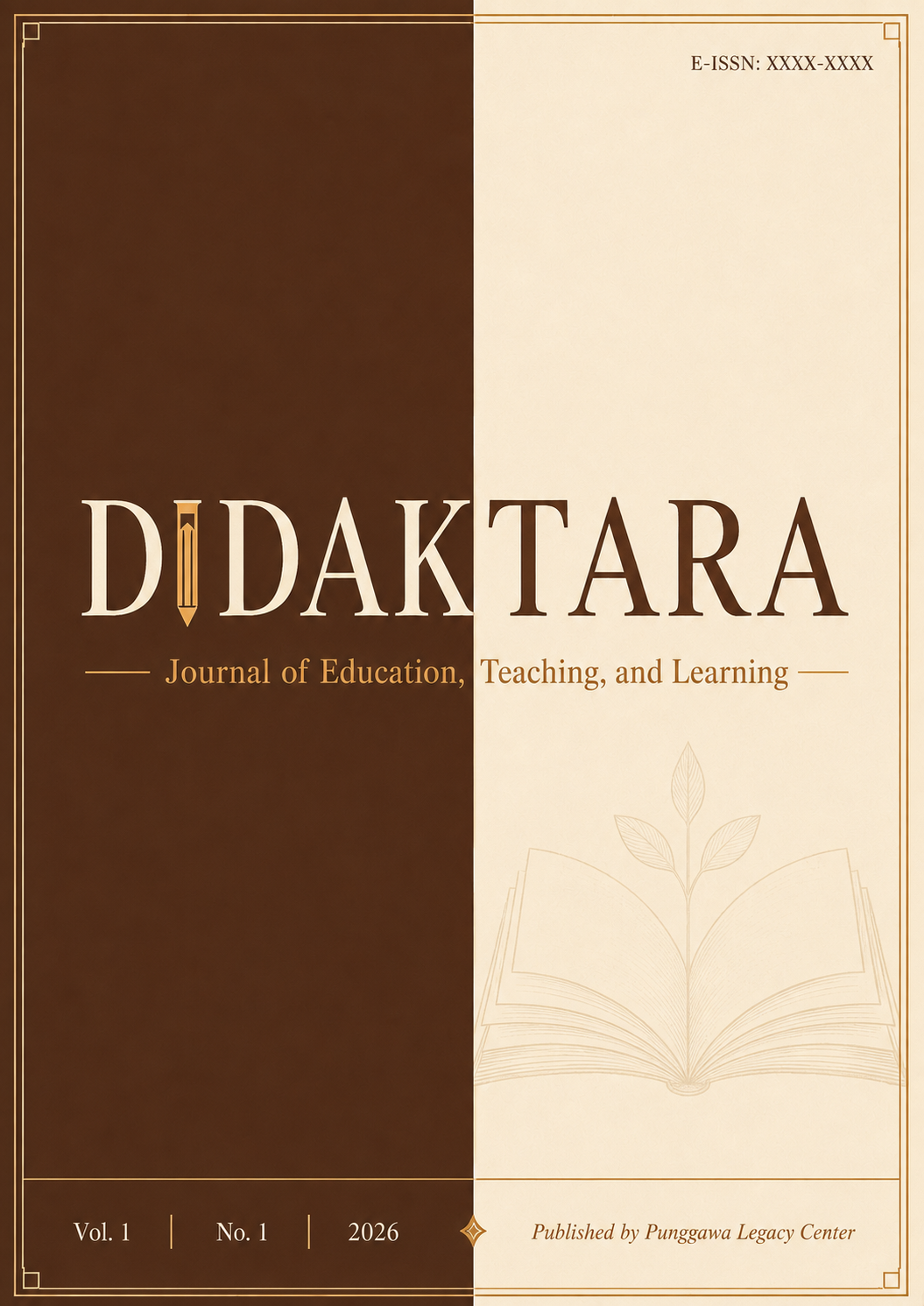
Vol. 1 No. 1 (2026): DIDAKTARA: Journal of Education, Teaching, and Learning
Published: 2026-07-31
DIDAKTARA: Journal of Education, Teaching, and Learning provides an academic forum for the exchange of research, ideas, and educational practices concerning the development of teaching and learning. The journal recognises education as a dynamic field shaped by the interaction of learners, educators, curricula, technologies, institutions, communities, and public policies.
The journal welcomes contributions from researchers, teachers, lecturers, educational practitioners, school leaders, postgraduate students, policymakers, and professionals working in different areas and levels of education. Manuscripts may examine educational issues in early childhood education, primary and secondary schools, vocational institutions, higher education, non-formal education, community learning, and lifelong education.
DIDAKTARA accepts original research articles, review articles, conceptual papers, classroom action research, development studies, case studies, comparative studies, and educational programme evaluations. Quantitative, qualitative, mixed-method, research and development, and interdisciplinary studies are welcome, provided that teaching, learning, or educational development remains the central focus of the manuscript.
DIDAKTARA is published quarterly, with issues released in March, June, September, and December
Indexing in