Punggawa Law Review is a peer-reviewed academic journal dedicated to advancing legal scholarship through critical, analytical, and interdisciplinary perspectives. The journal provides a scholarly platform for researchers, academics, legal practitioners, and policymakers to engage with contemporary legal issues at national, comparative, and international levels.

Punggawa Law Review welcomes contributions across a broad range of legal fields, including public and private law, criminal law and criminal justice, constitutional and administrative law, international and human rights law, business and economic law, environmental law, health law, and legal philosophy. The journal particularly encourages interdisciplinary and comparative research that explores the interaction between law and society.

Published quarterly (January, April, July, and October), Punggawa Law Review is committed to maintaining high editorial standards, a transparent peer review process, and open access principles to ensure the wide dissemination of scholarly knowledge. 

 

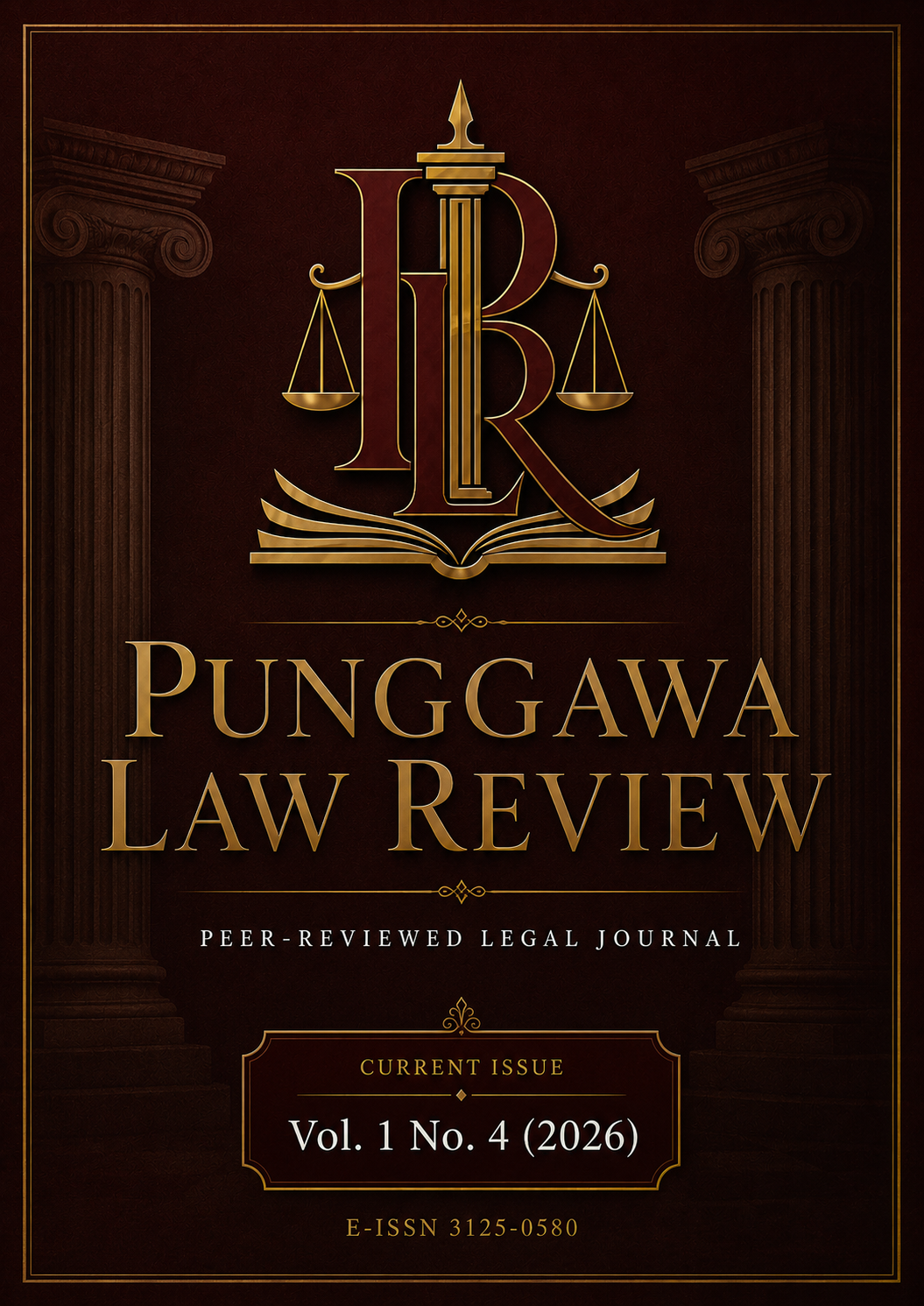
Vol. 1 No. 4 (2026): Punggawa Law Review: October

Published: 2026-09-01

Praktik Pembagian Warisan Sama Rata Dalam Keluarga Muslim Perspektif Hukum Islam

Akhmad Husein Abdillah, Muhammad Anshari, Muhammad Alfian Naja Rahmatulloh, Nor Nazla, Siti Lavina Liya (Author)

309-318

Perjanjian Kawin Persekutuan dengan Bersyarat

Salsabila Nurrahmah, Najwa Muntazah (Author)

319-325

Perlindungan Hukum Terhadap Hak Istri Dalam Perkara Perceraian Perspektif Hukum Islam Dan Hukum Positif

M. Alwi Romadani, Rahmat Al Farizi, Akhmad Haris, Siti Maisarah, Intan Aulia Ramadhani (Author)

387-397

Reorientasi Pembangunan Hukum Daerah dalam Negara Kesatuan: Dari Legislasi Perda menuju Tata Kelola Hukum Terpadu

Aprilya Yusri Attiyyah, Adrian Agus, Rahmat, Adithya Tri Firmansyah (Author)

398-408

The Ship Master's Legal Responsibility for Navigational Safety under Law Number 17 of 2008 on Shipping

Andi Nurulizzah Putri, Rerindita Sekar Seruni, Zul Fadly Ikram Basri (Author)

6-9

Community-Based Environmental Management: A Comparative Case Study of Bali, Indonesia and Branca, Timor-Leste

I Ketut Kasta Arya Wijaya, Ni Made Jaya Senastri, Luh Putu Suryani, Leonito Rebeirio (Author)

224-237

Hasil Paruman sebagai Hukum Tertinggi Desa Adat yang Otonom dalam Penyelesaian Sengketa Adat di Bali

I Made Suwitra, Ni Made Puspasutari Ujianti, Luh Kade Datrini (Author)

238-252

Perlindungan Hukum bagi Pedagang dalam Implementasi QRIS di Pasar Rakyat Kabupaten Bangli

Ni Made Puspasutari Ujianti, I Nyoman Gede Antaguna, Kadek Nadya Pramita Sari, Kharisma Nanda Sattwika, I Ketut Kasta Arya Wijaya (Author)

278-285

Kedudukan Anak Angkat dan Ahli Waris Beda Agama dalam Sistem Waris Islam

Asep Dwi Rahmatullah, Aditya Fatahilah (Author)

294-300

View All Issues

Punggawa Law Review is a peer-reviewed academic journal dedicated to advancing legal scholarship through critical, analytical, and interdisciplinary perspectives. The journal provides a scholarly platform for researchers, academics, legal practitioners, and policymakers to engage with contemporary legal issues at national, comparative, and international levels.

The journal publishes original research articles, theoretical analyses, and case-based studies that contribute to the development of legal doctrine, legal theory, and socio-legal understanding. Emphasis is placed on rigorous legal reasoning, methodological soundness, and innovative approaches to law in response to evolving social, political, economic, and technological challenges.

Punggawa Law Review welcomes contributions across a broad range of legal fields, including public and private law, criminal law and criminal justice, constitutional and administrative law, international and human rights law, business and economic law, environmental law, health law, and legal philosophy. The journal particularly encourages interdisciplinary and comparative research that explores the interaction between law and society.

Published quarterly, Punggawa Law Review is committed to maintaining high editorial standards, a transparent peer review process, and open access principles to ensure the wide dissemination of scholarly knowledge. Through these commitments, the journal seeks to foster meaningful academic dialogue and contribute to the development of legal thought at both national and global levels.


Indexing in